


Architecture of an Agentic AI System: The 6 Core Components Explained
Discover how autonomous AI systems are built – from planning engines to memory layers – with real-world examples and actionable insights.
Diagram: Agentic AI Architecture – Interconnected Components
This architecture diagram illustrates how an Agentic AI system is composed of multiple interconnected components that work together to perceive information, reason about it, plan actions, and execute decisions.
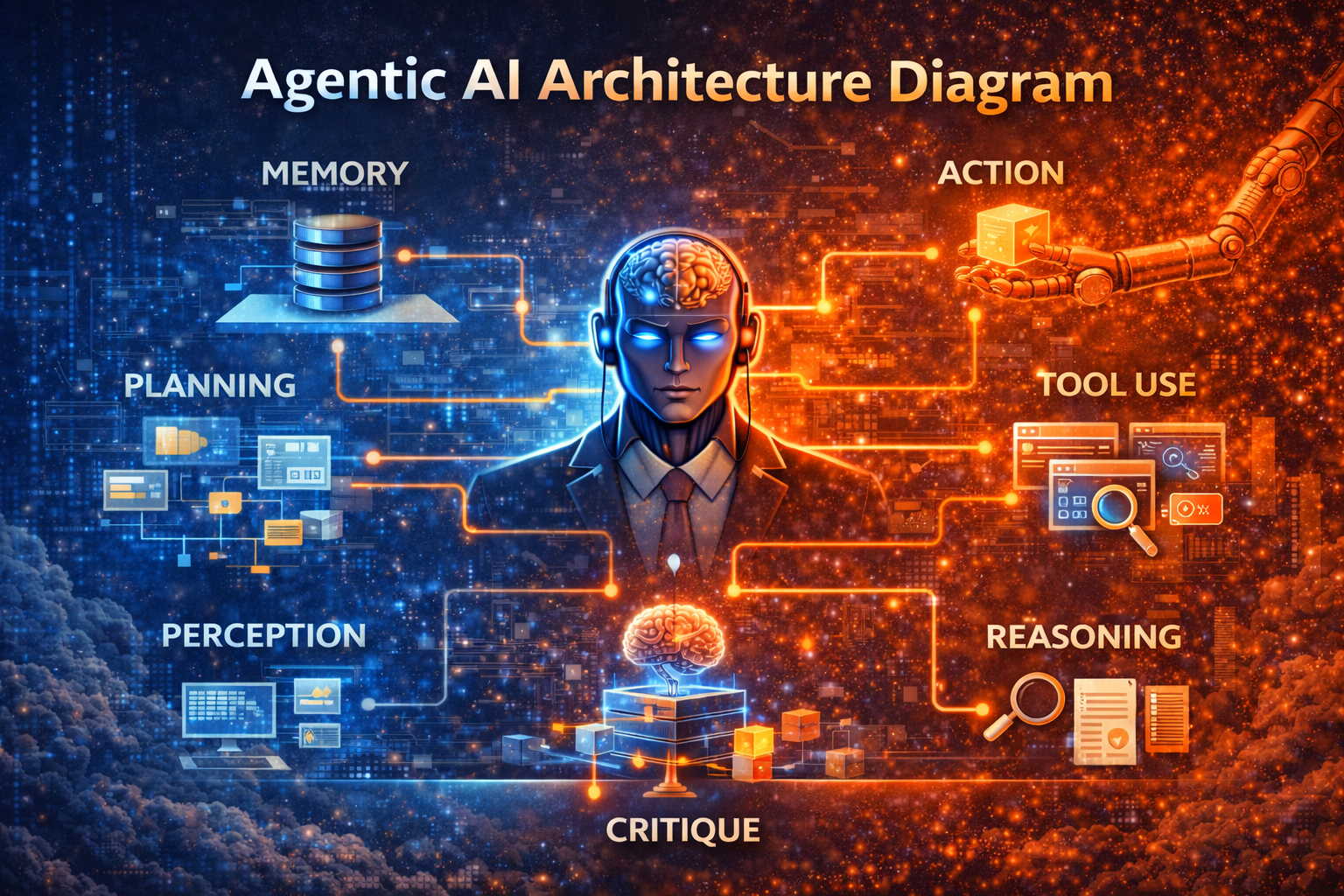
Unlike traditional AI systems, these components operate in a continuous feedback loop, allowing the agent to learn from outcomes and improve future decisions.
In our previous articles, we explored what Agentic AI is and when to use it. Now, let's pull back the curtain on how these systems are actually built. Unlike traditional AI models that simply process inputs to produce outputs, Agentic AI systems are complex architectures designed for autonomous decision-making and goal achievement.
Meet Sarah, a senior investment analyst at a hedge fund. Every Monday morning, she faces the same daunting task: analyze 500+ companies, track market movements, read 100+ research reports, and identify investment opportunities – all before the 9 AM meeting. She tried traditional AI tools, but they only provided fragmented insights without connecting the dots.
Enter Athena – an Agentic AI system specifically designed for financial analysis. Unlike previous tools, Athena doesn't just answer questions. She autonomously researches companies, analyzes historical patterns, compares market conditions, monitors news in real-time, and generates investment theses with risk assessments. This isn't magic – it's sophisticated architecture at work.
Let's dissect exactly how systems like Athena are architected...
The 6 Core Components of Agentic AI Architecture
Every effective Agentic AI system is built on these interconnected components:
1. Planning & Reasoning Engine
The "brain" that breaks down complex goals into actionable steps.
- Task Decomposition: Splits "Analyze market trends" into 15 sub-tasks
- Reasoning Chains: Creates logical step-by-step plans
- Adaptive Replanning: Adjusts when obstacles appear
- Cost-Benefit Analysis: Evaluates different approaches
2. Tool Executor & API Layer
The "hands" that interact with the external world.
- Tool Registry: Catalog of available capabilities
- API Integrations: Connects to databases, web services, software
- Parameter Mapping: Converts plans to API calls
- Error Handling: Manages failed tool executions
3. Memory Systems (Multi-Layer)
The "experience" that learns from interactions.
- Short-term Memory: Current conversation/context
- Long-term Memory: Vector databases for knowledge
- Procedural Memory: Learned skills and workflows
- Episodic Memory: Past experiences and outcomes
4. Execution Orchestrator
The "conductor" that manages the workflow.
- State Management: Tracks current progress
- Parallel Execution: Runs compatible tasks simultaneously
- Dependency Resolution: Manages task sequences
- Timeout Handling: Prevents infinite loops
5. Reflection & Evaluation Module
The "quality control" that ensures output excellence.
- Self-Critique: Reviews its own work
- Fact-Checking: Verifies information accuracy
- Goal Alignment: Ensures outputs match objectives
- Iteration Loop: Improves through feedback
6. Communication Interface
The "voice" that interacts with users and other agents.
- Natural Language Processing: Understands and generates human language
- Multi-Modal Support: Handles text, images, data
- Agent-to-Agent Protocol: Enables collaborative systems
- Progress Reporting: Updates users on status
How It All Flows Together: The Athena Example
Let's see how Sarah's Athena system processes "Find undervalued tech stocks in Q2 2024":
Goal Reception & Planning
The Planning Engine receives Sarah's query and creates a 7-step plan: (1) Identify tech sectors, (2) Pull financial data, (3) Analyze valuation metrics, (4) Check news sentiment, (5) Compare to historical patterns, (6) Assess risks, (7) Generate recommendations.
Tool Execution & Data Gathering
The Tool Executor calls multiple APIs simultaneously: Bloomberg for financials, Google News for sentiment analysis, Crunchbase for funding data, and internal databases for historical patterns. All results are stored in Short-term Memory.
Analysis & Reasoning
The system compares current P/E ratios to 5-year averages, checks if negative news affected similar stocks historically, identifies companies with strong fundamentals but depressed prices due to temporary factors.
Reflection & Quality Check
The Reflection Module reviews the analysis: "Does the recommendation consider the current interest rate environment? Have we checked for pending lawsuits? Is the data source reliable?" It identifies gaps and triggers additional research.
Output Generation & Learning
Athena generates a comprehensive report with 3 strong recommendations, 2 cautious considerations, and 5 risks to monitor. The entire workflow is saved to Long-term Memory, improving future analyses.
Architecture Variations for Different Use Cases
Healthcare Diagnosis Assistant
Unique Architecture Needs:
- Medical knowledge graph integration
- High-confidence thresholds (95%+)
- Explainability requirements for each diagnosis
- HIPAA-compliant memory systems
Emphasis on safety, explainability, and regulatory compliance.
E-commerce Personal Shopper
Unique Architecture Needs:
- Real-time inventory API connections
- User preference learning over time
- Multi-vendor price comparison engines
- Conversational recommendation systems
Focus on personalization, real-time data, and conversion optimization.
Research Paper Co-Author
Unique Architecture Needs:
- Academic database integrations (PubMed, arXiv)
- Citation and reference management
- Plagiarism checking capabilities
- Collaborative editing interfaces
Priority on accuracy, citation integrity, and academic standards.
🚀 Implementation Roadmap for Technical Teams
Phase 1: Foundation (Weeks 1-4)
- Define clear use case and success metrics
- Set up basic tool executor with 3-5 critical APIs
- Implement simple planning engine
- Build MVP with single workflow
Phase 2: Enhancement (Weeks 5-12)
- Add multi-layer memory system
- Implement reflection and self-correction
- Expand tool library to 15-20 capabilities
- Add parallel execution capabilities
Phase 3: Production (Months 4-6)
- Scale to handle 1000+ concurrent requests
- Implement comprehensive monitoring
- Add multi-agent collaboration features
- Enterprise security and compliance
Key Takeaways for Architects & Developers
🎯 Start with the Goal, Not the Technology
Design your architecture around specific user goals, not technical capabilities. Athena works because she's designed for investment analysis, not general conversation.
🔄 Build Iteratively, Not Monolithically
Start with a simple planning-execution loop, then add memory, then reflection, then collaboration. Don't try to build everything at once.
📊 Measure What Matters
Track: (1) Goal completion rate, (2) Steps to completion, (3) Tool execution success rate, (4) User satisfaction scores, (5) Cost per successful task.
The architecture of Agentic AI systems represents a fundamental shift from static models to dynamic, goal-oriented architectures. By understanding these six core components and how they interact, you're equipped to build systems that don't just answer questions – they accomplish objectives.
📚 Further Reading in This Series:
- Part 1: What is Agentic AI? Beyond Chatbots & RAG
- Part 2: From Static Search to Historical Reasoning
- Part 3: When NOT to Use Agentic AI
- Part 4: Architecture of Agentic AI Systems (You're Here)
- Coming Soon: Part 5: Building Your First Agentic AI System