


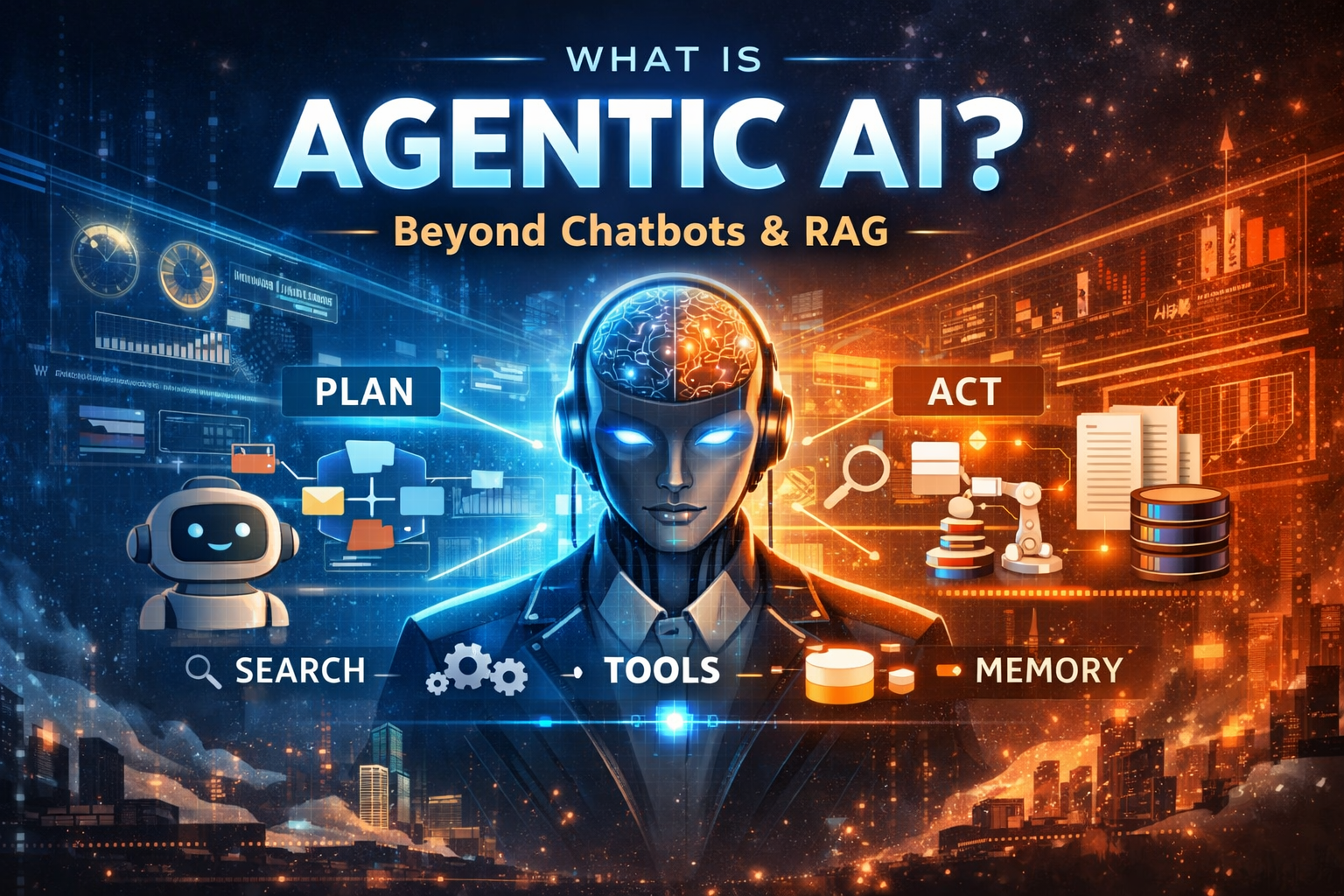
Introduction: Why “Agentic AI” Is the Next Big Shift
For years, AI systems have been reactive.
-
You ask a question → AI answers.
-
You search data → AI summarizes.
-
You retrieve documents → AI paraphrases.
This worked well for chatbots and RAG (Retrieval Augmented Generation) systems.
But modern problems—policy analysis, historical reasoning, enterprise decision-making, and government workflows—need more than just answers.
They need AI that can think, plan, act, and learn.
That’s where Agentic AI comes in.
What Is Agentic AI? (Simple Definition)
Agentic AI is a type of artificial intelligence system that can:
Understand a goal
Plan multiple steps
Use tools and data sources
Reason over history and context
Take actions
Evaluate outcomes and adapt
In short:
Agentic AI behaves less like a chatbot and more like a junior analyst, assistant, or decision-support officer.
Why Chatbots and RAG Are Not Enough Anymore
1. Traditional Chatbots
Chatbots:
-
Respond only to user prompts
-
Have no memory of past interactions
-
Cannot take actions
-
Do not verify or plan
They are reactive, not proactive.
2. RAG (Retrieval Augmented Generation)
RAG improved things by:
-
Fetching documents
-
Grounding responses in data
-
Reducing hallucinations
But RAG still:
-
Answers one question at a time
-
Cannot plan multi-step tasks
-
Cannot decide what to do next
Key Limitation
Both chatbots and RAG wait for instructions.
Agentic AI creates and executes its own plan.
Chatbot vs RAG vs Agentic AI
Suggested Infographic Layout:
| Feature | Chatbot | RAG | Agentic AI |
|---|---|---|---|
| Memory |  No No |
 Limited Limited |
 Long & Short-term Long & Short-term |
| Tool Usage | No |
No |
Yes |
| Multi-step Planning | No |
No |
Yes |
| Decision Making | No |
No |
Yes |
| Learning from History | No |
No |
Yes |
| Autonomy | No |
No |
Semi / Full |
Core Characteristics of Agentic AI
1. Goal-Oriented Behavior
Agentic AI doesn’t just respond—it works toward a goal.
Example goals:
-
“Analyze past tenders and suggest the best bid strategy”
-
“Review 10 years of policy changes and summarize impacts”
-
“Compare historical market trends and predict risks”
2. Planning & Reasoning
Agentic AI breaks a goal into steps:
-
Identify required data
-
Retrieve relevant history
-
Analyze patterns
-
Validate assumptions
-
Generate output
-
Recommend actions
This is called the Plan → Act → Observe → Reflect loop.
3. Tool Usage
Unlike chatbots, Agentic AI can:
-
Query databases
-
Search internal systems
-
Call APIs
-
Read files (PDFs, Excel, CSV)
-
Trigger workflows
It does things, not just says things.
4. Memory & Context Awareness
Agentic AI maintains:
-
Short-term memory: current task context
-
Long-term memory: historical knowledge
-
Episodic memory: past decisions & outcomes
This makes it ideal for historical reasoning systems.
Agentic AI Decision Loop

How Agentic AI Thinks: A Practical Example
Scenario: Historical Policy Analysis
User Goal:
“Analyze how industrial policy changes from 2010–2024 impacted MSMEs.”
Agentic AI Steps:
-
Search policy documents by year
-
Extract MSME-related clauses
-
Compare policy changes chronologically
-
Identify impact patterns
-
Cross-reference outcomes
-
Generate insights + recommendations
A chatbot would summarize documents.
Agentic AI builds an analysis.
Agentic AI Architecture (High-Level)
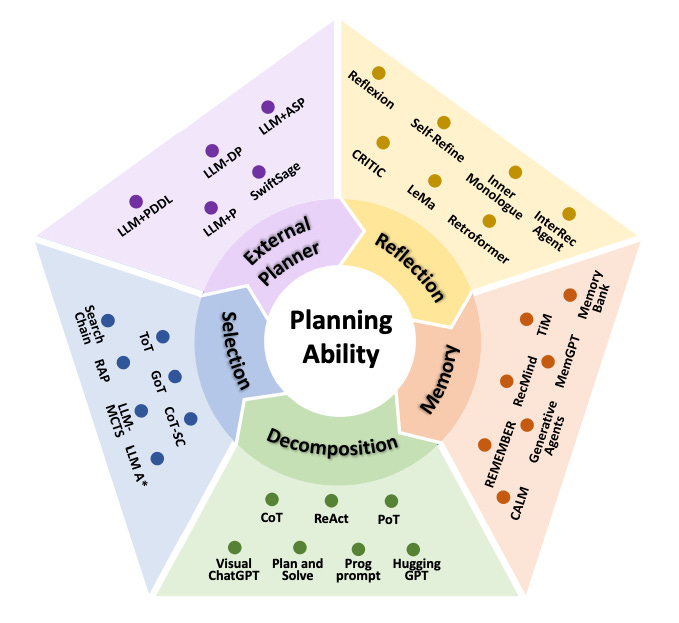
Core Components:
-
LLM (Reasoning Brain)
-
Memory Layer (Vector DB + Structured DB)
-
Tool Layer (APIs, Search, Databases)
-
Planner / Orchestrator
-
Guardrails & Governance
-
Human-in-the-Loop (Optional)
Why Agentic AI Matters for Different Audiences
 Backend Developers & Data Science Beginners
-
Learn system design beyond prompts
-
Build real-world AI workflows
-
Move from “toy chatbots” to production systems
 Government & Public Sector Managers
-
Policy comparison & precedent analysis
-
Decision traceability
-
Reduced dependency on manual research
 Enterprises & Large Clients
-
Strategic intelligence
-
Risk analysis
-
Faster, explainable decisions
Agentic AI vs Autonomous AI (Important Clarification)
Agentic AI is not fully autonomous by default.
| Type | Control Level |
|---|---|
| Assistive Agent | High human control |
| Semi-Agentic | Human approval required |
| Fully Autonomous | Minimal human input |
Most real-world systems today use controlled agentic AI.
Common Misconceptions About Agentic AI
“Agentic AI is just better prompting” It’s system-level design
“Agentic AI replaces humans” It augments decision-making
“Only big companies can use it” Scalable from startups to governments
Real-World Use Cases
-
Historical intelligence systems (Rufus-style)
-
Tender & procurement analysis
-
Enterprise knowledge assistants
-
Policy impact simulators
-
Compliance & audit assistants
-
Strategic planning tools