
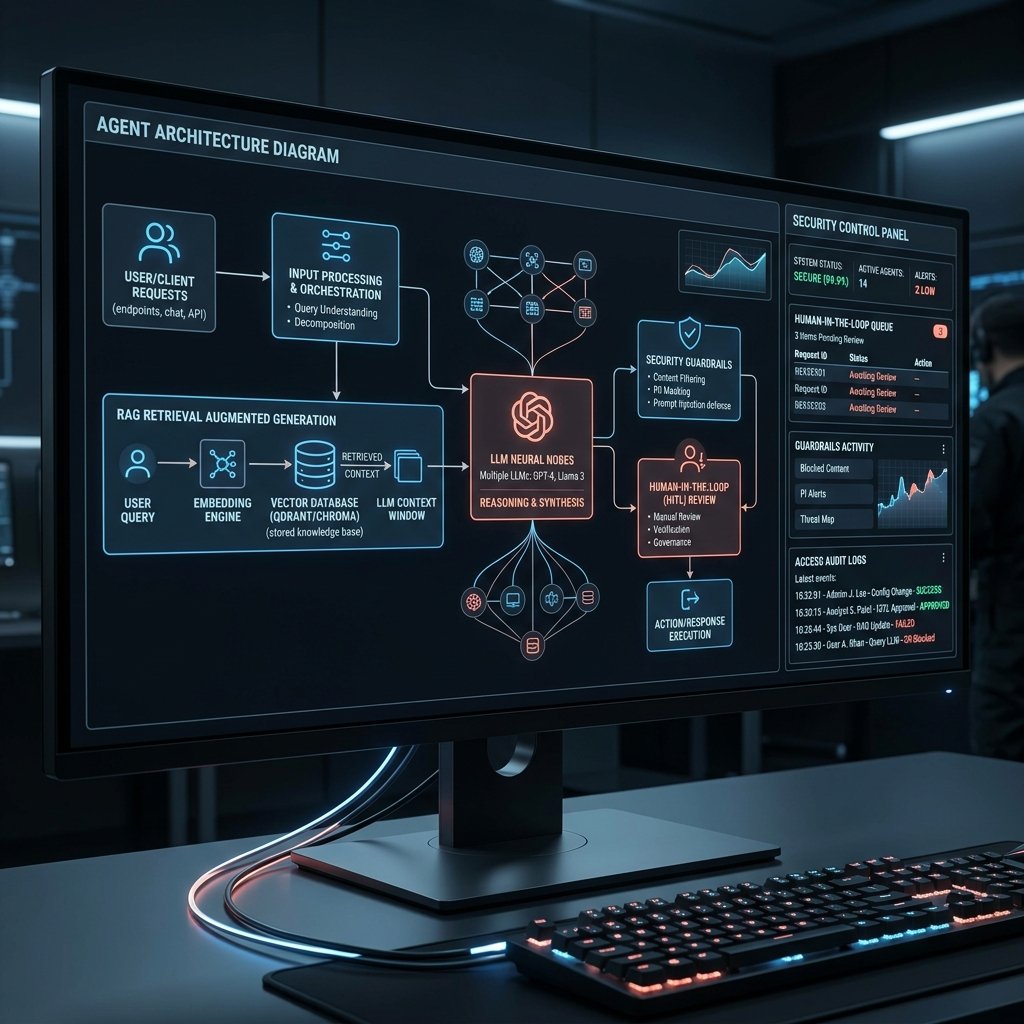
Beyond Basic Chatbots: Defining Autonomous Enterprise AI Agents
Enterprise AI agents differ fundamentally from simple LLM prompt wrappers. An autonomous AI agent evaluates user intent, retrieves relevant context from internal knowledge bases, executes tool actions via API calls, and operates within strict security guardrails. For enterprise organizations in India, deploying AI agents requires robust data architecture to ensure sensitive business records, pricing models, and customer PII (personally identifiable information) remain protected.
Retrieval-Augmented Generation (RAG) vs. Model Fine-Tuning
Architecture Aspect | Retrieval-Augmented Generation (RAG) | Fine-Tuned Base LLM --- | --- | --- Data Knowledge Base | Dynamic vector database (Qdrant, Pinecone, PGVector) | Baked into model weights Update Frequency | Real-time vector indexing (< 1 second) | Expensive re-training cycles Data Privacy | Strict document-level access control | Risk of training data leaks Accuracy & Hallucinations | Grounded in retrieved source documents | Susceptible to hallucinated facts Cost Overhead | Low (Pay only for vector storage & embeddings) | High (GPU compute & training costs)
Human-in-the-Loop (HITL) Guardrails & Role Audit Logs
For high-risk operations—such as approving commercial quotes, issuing refunds, or updating medical records—AI agents must enforce Human-in-the-Loop (HITL) escalation rules. When an agent's confidence score drops below 95% or when an action involves financial commitments, the workflow pauses and alerts an authorized staff manager via Slack/WhatsApp/CRM with full conversation audit logs.