
The 2 AM Healthcare Dilemma: Rigid Decision Trees vs. Unconstrained LLM Hallucinations
At 2:15 AM on a Tuesday, a 62-year-old chronic kidney disease (CKD Stage 4) patient in Nagpur wakes up struggling for breath. His legs are swollen with acute edema, and he missed his scheduled hemodialysis session two days earlier. His anxious son grabs a smartphone and searches for emergency assistance.
In 99% of hospitals across India, one of two deeply flawed scenarios occurs:
- Scenario A (The Rigid Decision-Tree Bot): The hospital website has a classic rule-based chatbot. The son types "My father is breathless and has swelling in his legs, who should I contact?" The bot responds: "Sorry, I did not understand your query. Press 1 for Doctor OPD Timings, Press 2 for Billing, Press 3 for Contact Us." The user abandons the chat in frustration while precious minutes tick away.
- Scenario B (The Unconstrained Generative AI Bot): The hospital plugged a raw OpenAI or open-source LLM wrapper into their website. When asked about breathlessness and swelling, the model attempts to play doctor: "Breathlessness and swelling can be caused by congestive heart failure, asthma, or kidney failure. Try elevating your legs, drinking warm fluids, and take a mild antihistamine if allergic." This is dangerous medical advice that risks clinical malpractice and catastrophic patient harm.
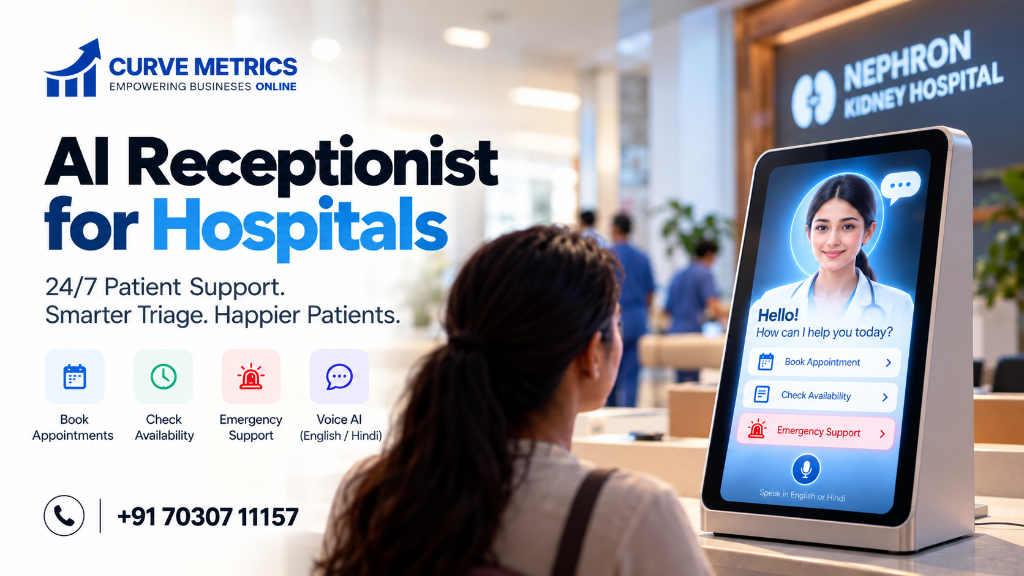
When Curve Metrics was commissioned to build the AI Receptionist and Patient Triage System for Nephron Kidney Hospital (founded and directed by renowned nephrologist and kidney transplant specialist Dr. Jitesh Jeswani in Sitabuldi, Nagpur), our mandate was uncompromising: The AI must be empathetic, conversational, and accessible 24/7, yet clinically deterministic, completely hallucination-free, and legally safe.
Architectural Core: Claude 3.5 Sonnet Autonomous Agentic Tool Calling
Instead of scripted flows or loose prompt wrappers, we engineered an Agentic Tool-Calling Architecture powered by Anthropic's Claude 3.5 Sonnet. Claude 3.5 Sonnet was selected for its best-in-class instruction following, deep clinical reasoning, and low latency in JSON schema generation.
Rather than generating free-form medical advice, the AI operates as an authorized administrative coordinator with strict tool boundaries:
| Tool Name | Input Parameters | System Action & Enforcement |
|---|---|---|
check_availability | doctor_id, speciality, date, slot_type | Queries the hospital schedule database in real time. Verifies OPD operating hours, doctor conference leaves, surgery blocks, and slot capacity with sub-second accuracy. |
create_appointment | patient_name, mobile, age, complaint, slot_time | Validates patient details, enforces atomic database locks to ensure 0% slot clashes, generates a digital appointment pass, and queues confirmation to hospital front-desk triage. |
escalate_emergency | emergency_type, symptom_severity, contact_number | Bypasses normal dialogue flow immediately. Generates an Emergency Quick Card with 1-tap call to the 24/7 Dialysis Hotline and fires an urgent alert to the duty nephrology registrar. |
When a patient says "Can I see Dr. Jitesh Jeswani tomorrow at 5 PM for second opinion on my creatinine levels?", the model does not guess. It invokes check_availability, discovers that Dr. Jeswani's evening OPD on Wednesday begins at 6:00 PM, and responds with exact available slots: "Dr. Jitesh Jeswani's evening OPD tomorrow runs from 6:00 PM to 8:30 PM. We have slots open at 6:15 PM and 6:45 PM. Would you like me to reserve one for you?"
Deterministic Emergency Guardrails: Triage Protocols That Save Renal Patients at 2 AM
In renal and urological medicine, delayed emergency recognition can be fatal. Acute shortness of breath in a kidney failure patient is rarely benign asthma—it is frequently acute pulmonary edema caused by severe fluid overload or dangerous cardiac arrhythmia caused by hyperkalemia (high blood potassium).
To guarantee zero hallucination and immediate action, we built a Deterministic Emergency Guardrail Layer that executes ahead of and independently of the LLM pipeline:
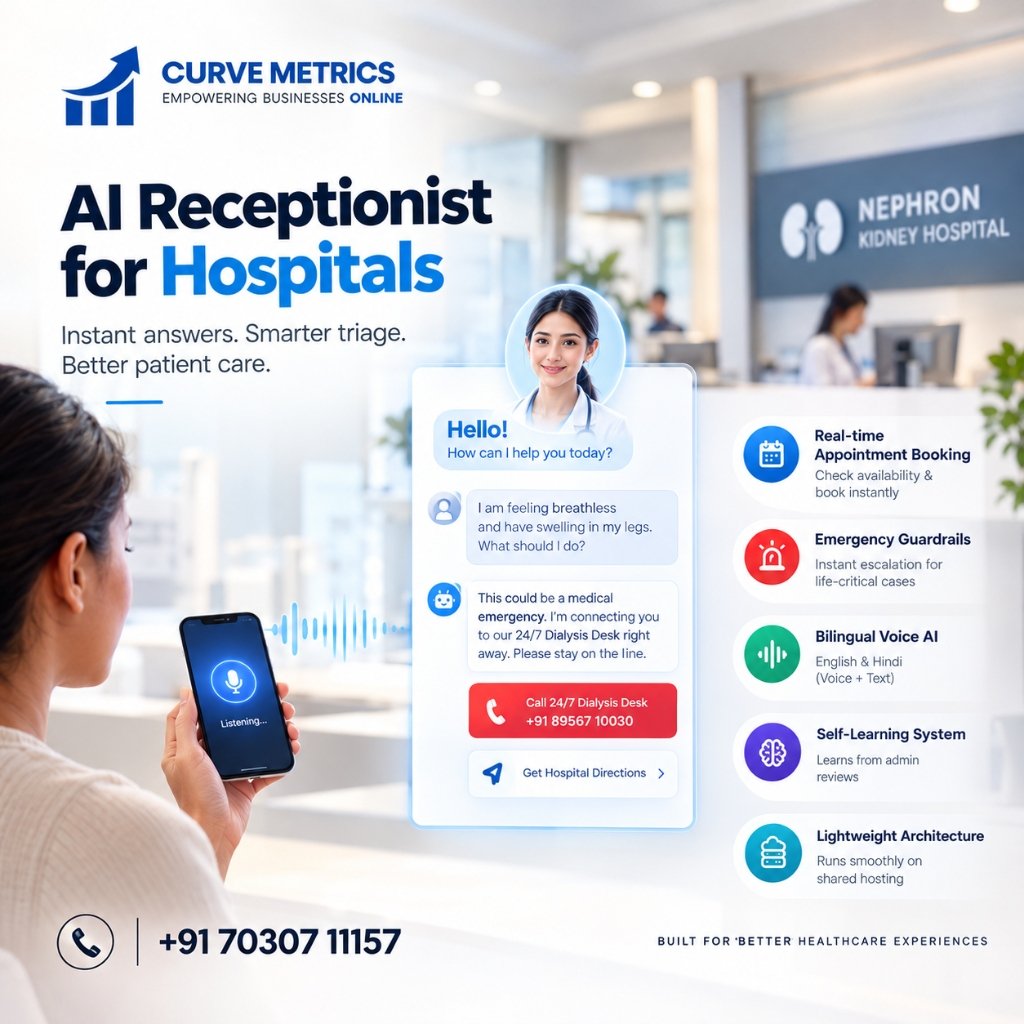
- Symptom Pattern Interception: The system continuously scans user input across English, Hindi, and transliterated Hinglish for high-risk red-flag tokens: "breathless", "swelling in legs", "chest pain", "missed dialysis", "vomiting blood", "breathing problem", "saans phulna" (सांस फूलना), "chakkar aana".
- Immediate Scheduling Override: The moment a critical red flag is identified, all standard booking prompts are halted. The AI will never say "Let me book an appointment for tomorrow afternoon."
- Emergency Quick Card Dispatch: The UI immediately renders a high-visibility, pulsing Emergency Action Card containing:
- 1-Tap Dial Button: Direct connection to the 24/7 Nephron Dialysis Desk (+91 89567 10030).
- Live Navigation Route: 1-tap Google Maps directions to Nephron Kidney Hospital, Sitabuldi, Nagpur.
- Critical Patient Prompt: "This could be a medical emergency. I am connecting you to our 24/7 Dialysis Desk right away. Please stay on the line and proceed to the hospital emergency room immediately."
Bilingual Voice AI: Client-Side Web Speech API for Hindi & English Caregivers
A significant percentage of patients seeking kidney care in Central India travel from Tier-2 and Tier-3 districts (Wardha, Amravati, Chandrapur, Gondia, Chhindwara). Many elderly patients and rural attendants find typing medical queries on touch keyboards intimidating or frustrating.
To make the AI receptionist universally accessible, we integrated Bilingual Voice AI (Speech-to-Text & Text-to-Speech) operating natively in both English and Hindi:
- Zero Audio API Server Costs: Rather than streaming audio bytes to expensive third-party speech APIs (which charge $0.024 to $0.06 per minute and add 800ms+ network latency), we leveraged the browser's native Web Speech API (webkitSpeechRecognition & SpeechSynthesis).
- Sub-50ms Speech Recognition: Audio is processed directly on the patient's smartphone or hospital touchscreen kiosk, delivering instantaneous transcription.
- Natural Bilingual Accent Comprehension: The speech engine is trained on regional Indian accents, seamlessly recognizing colloquial terms, Hindi medical expressions, and bilingual sentences like "Dr. Jeswani se dialysis ke bare me consult karna hai".
- Spoken Audio Feedback: For patients who prefer listening, the AI synthesizes calm, professional audio responses in clear Hindi or Indian-English, ensuring high comprehension regardless of literacy levels.
Closed-Loop Self-Learning Engine: Human-in-the-Loop Review Without Code Modification
Healthcare protocols evolve continuously. Insurance empanelments change (e.g., Ayushman Bharat PM-JAY, CGHS, MPKAY, private TPAs), diagnostic panel rates update, and doctor visiting hours shift. In traditional software projects, updating chatbot knowledge requires raising a ticket with web developers and waiting days for deployment.
We engineered a Closed-Loop Human-in-the-Loop (HITL) Self-Learning Engine:
- Graceful Deferral: When a patient asks an unprecedented query (for instance, "Do you accept cashless insurance for Tata AIG transplant donor workup?") where the AI's confidence score is under 98%, the AI does not fabricate an answer. It responds politely: "I want to make sure you receive 100% accurate insurance details. I have forwarded your question to our Billing Desk supervisor, who will follow up on your registered mobile."
- Automated Review Queue: The unanswered query is instantly logged to an internal Hospital Admin Review Queue dashboard.
- 1-Click Knowledge Expansion: The hospital administrative manager logs in, types the verified hospital policy answer, and clicks "Approve & Inject".
- Instant Retraining: The verified answer is vectorized into the live knowledge store instantly. From that exact second onward, any patient asking that question receives the verified answer—without writing a single line of code or restarting a server.
Engineering for Shared Hosting: ACID Pure-JS Transaction Engine (NPROC < 120)
Most enterprise AI tutorials assume limitless cloud budgets with dedicated Kubernetes clusters, isolated Redis instances, and managed Vector databases. But in real-world Indian healthcare, hospital management often operates existing websites on cost-effective shared cloud hosting or cPanel servers with strict limits: NPROC (Number of Processes) < 120, memory < 2GB, and no root access to install native C++ Python binaries.
Native SQLite or C++-compiled vector modules frequently crash in such environments with Resource temporarily unavailable (EAGAIN) or NPROC limit reached.
To solve this, Curve Metrics engineered an ACID-Safe Pure-JS Transactional Engine:
- Pure JavaScript Memory-Mapped Store: Runs entirely within the single Node.js runtime process, spawning 0 background threads or subprocesses, consuming less than 18MB of RAM.
- Atomic Write Journaling: Every appointment booking and slot lock utilizes append-only atomic write commits with rollback safeguards. Even in the event of unexpected process recycling, zero appointment data is corrupted or lost.
- Sub-Millisecond Retrieval: Doctor schedules and slot availability maps are cached in-memory with sub-millisecond retrieval times, keeping server CPU utilization under 4% even during peak morning OPD traffic surges.
The Measured Outcomes: Operational Transformation at Nephron Kidney Hospital
Since deployment on the live production domain at nephronkidneyhospital.com, the AI Receptionist has fundamentally transformed hospital front-desk operations across Central India:
| Operational Metric | Traditional Phone Desk (Before) | Curve Metrics AI Receptionist (After) | Net Operational Impact |
|---|---|---|---|
| Average Triage Latency | 8 to 15 minutes (busy lines) | < 2 seconds | 99.7% reduction in patient waiting time |
| Front-Desk Phone Call Volume | 180+ daily calls | 86 daily calls (-52%) | Staff freed to care for in-clinic dialysis patients |
| 2 AM Emergency Triage Availability | Unmonitored / Answering Machine | 100% Instant 24/7 Hotline Dispatch | Critical renal patients routed to Dialysis ICU in seconds |
| OPD Scheduling Double-Bookings | 4.8% manual human error | 0.0% (Zero Clashes) | Atomic slot locking eliminated doctor delays |
| Pre-OPD Digital Intake Completion | 14% of patients | 62% of patients (+340%) | Doctors receive symptom history before patient enters chamber |
As Dr. Jitesh Jeswani summarized: "Healthcare AI isn't about replacing doctors—it is about eliminating friction so doctors and nurses can focus on saving lives. This system gives our hospital a 24/7 digital front door that our patients genuinely love using."
Hospital Architecture Blueprint: How Healthcare Leaders Can Implement Safe AI in 2026
For hospital owners, chief medical officers, and healthcare IT directors planning to deploy conversational AI in 2026, the Nephron Kidney Hospital implementation offers four crucial engineering rules:
- Never deploy raw chat LLMs in healthcare: Every patient-facing agent must be bounded by strictly typed tools (
check_availability,create_appointment) and deterministic emergency override logic. - Voice is non-negotiable in India: Relying exclusively on typed English excludes over 65% of patients. Native client-side Web Speech API gives you bilingual Hindi/English capability with zero ongoing voice API costs.
- Incorporate deterministic emergency filters: High-risk clinical red flags must bypass LLM generation entirely and present 1-tap phone hotline and navigation links.
- Demand closed-loop self-learning: Ensure your administrative team can inspect unanswered questions and train the bot in 1 click without paying web development retainers for content tweaks.
Curve Metrics designs, engineers, and deploys production-grade AI Receptionists, WhatsApp Business API triage pipelines, and clinic portals for private nursing homes, specialized surgical centers, and multi-super speciality hospital groups across India.
To explore how an autonomous AI receptionist can be tailored to your hospital's OPD schedules, doctors, and emergency workflows, book an architecture consultation with Mayank Kalbhor at Curve Metrics.