Overview & Key Takeaways
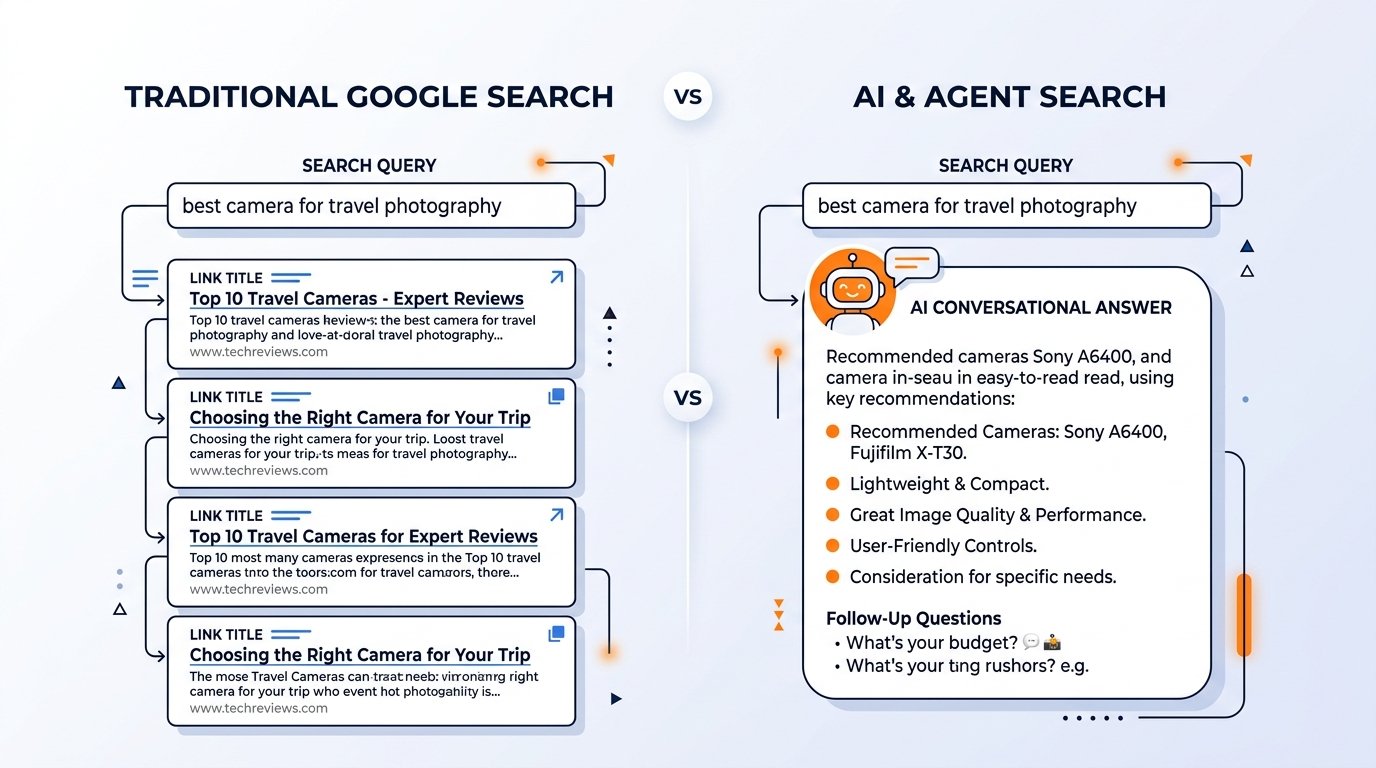
Key Takeaways / TL;DR: - Search is shifting from links to synthesized answers: Traditional Google search drives traffic through 10 blue links. Conversational AI search engines (ChatGPT Search, Perplexity, Google AI Overviews) synthesize answers directly on-screen, causing organic click-through rates on traditional SERPs to drop significantly. - Keywords are dead; Entities and Schemas rule: Large Language Model (LLM) crawlers look beyond keyword density. They crawl for structured data (JSON-LD), entity relationships, sub-second web architecture API speeds, and verifiable topical authority clusters. - Discovery is only half the equation: Once an AI agent cites your business, your site must convert immediately. Next.js/React headless architectures combined with 24/7 autonomous AI agents and WhatsApp automation turn AI discovery into direct pipeline revenue.
1. Introduction: The Death of the 10 Blue Links
For over two decades, the digital marketing playbook followed a predictable sequence: research high-volume keywords, optimize meta tags, publish 2,000-word skyscraper articles, accumulate backlink volume, and compete for a spot in Google's 10 blue links. In 2026, that legacy playbook is failing. Searcher behavior has fundamentally transformed. Modern users — ranging from B2B buyers to clinic patients and e-commerce shoppers — no longer submit short keyword fragments like 'best dental clinic in Mumbai pricing' to compare five browser tabs. Instead, they prompt conversational AI search tools with multi-variable intent: 'Find me a top-rated cosmetic dentist in Mumbai who specializes in porcelain veneers, accepts premium insurance, offers evening appointments, and let me book directly via WhatsApp.' In this conversational landscape, there are no SERP pages 2 or 3. In most cases, there is a single synthesized answer supported by 2-3 cited source links. If your company's digital infrastructure is not formatted specifically for Large Language Model (LLM) indexing, your business is invisible to an expanding demographic of decision-makers. The primary risk for modern businesses is the zero-click search: if your brand is omitted from AI answer summaries, your sales pipeline dries up before a prospective customer ever visits your domain.
2. Anatomy of the Shift: Traditional SEO vs. AI & Agentic Search (AEO & GEO)
To adjust digital strategy, technical leads and agency partners must separate Traditional Search Engine Optimization (SEO) from Answer Engine Optimization (AEO) and Generative Engine Optimization (GEO). Traditional SEO Targets Search Engine Spiders (Googlebot, Bingbot) focusing on Keywords, Meta Tags, Backlink Volume, and Word Count. User UX requires browsing multiple links & manual comparison. Output: Organic Website Clicks. AEO & GEO Targets LLM Crawlers & Autonomous Agents (GPTBot, PerplexityBot, Google-Extended) focusing on Entities, Semantic Context, Deep JSON-LD Schema, and Knowledge Graphs. User UX receives direct, synthesized answers with citation links. Tech Stack: Headless Next.js/React, fast API endpoints, structured data micro-formats. Output: AI Citation, Direct Agent Referral, and Conversational Lead Capture. How LLM Crawlers Parse and Cite Authoritative Sources: Unlike Googlebot (which indexed raw HTML text for keyword frequencies), LLM crawlers parse content to construct Knowledge Graphs. They evaluate: 1. Factual Density: Ratio of verifiable data, attributes, and schema-marked facts to narrative fluff. 2. Entity Disambiguation: Clear, machine-readable definitions of who you are, what services you provide, practitioner/engineer credentials, and physical coverage areas. 3. Machine Readability: The execution speed of your API payloads and how efficiently an AI agent can read un-rendered content blocks without executing expensive client-side scripts.
3. The 4 Pillars of Making Your Business AI-Search Ready
To position your business as a preferred citation source for conversational search engines, your software architecture must rely on four foundational pillars: Pillar 1: Entity-First Optimization & Deep Schema Markup In Generative Engine Optimization, Schema Markup (JSON-LD) serves as your primary API interface for the AI-driven web. LLMs do not make assumptions; they require explicit data relationships. Your application must embed nested schemas across key pages: Organization & LocalBusiness, Service / MedicalBusiness / Product, and FAQPage & HowTo. Pillar 2: Sub-Second Modern Web Architectures (Next.js / React) Monolithic CMS environments (e.g., WordPress sites laden with third-party plugins) hinder performance on the AI web. Slow server processing, render-blocking scripts, and cluttered HTML consume the token budget of AI crawlers. Next.js delivers Server-Side Rendering (SSR) & Static Site Generation (SSG) with Edge Acceleration and clean API endpoints. Pillar 3: Problem-Solving Authoritative Content (Topical Clusters) Chasing generic phrases creates thin, unhelpful content. GEO demands topical depth and structured problem-solving through Topical Clusters, Direct Answer Paragraphs (40-50 words), and Data Tables. Pillar 4: Autonomous Lead Conversion & AI Agents Securing an AI citation is only step one. When a customer follows an AI referral link to your site, they expect an immediate, conversational experience. Modern web architectures integrate 24/7 Autonomous AI Agents & WhatsApp Automation.
4. Practical Audit Checklist: Is Your Business AI-Search Ready?
Use this technical audit checklist to evaluate your platform's readiness for AEO and GEO: 1. Performance & Infrastructure: - TTFB < 200ms - Bot Access Verified (GPTBot, PerplexityBot, ClaudeBot, Google-Extended in robots.txt) - Pre-rendered Content Delivery 2. Structured Data & Schema: - Validated Organization & LocalBusiness JSON-LD - Service & Product Schemas - FAQ Microdata 3. Content Architecture (GEO): - Direct Answer Block (40-50 words under H2) - Structured Markdown Tables - Interlinked Topical Clusters 4. Conversational Conversion Engine: - Direct WhatsApp Actions - 24/7 AI Lead Qualifier
5. Build Your AI-Ready Stack with Curve Metrics
Organizations that adopt Generative Engine Optimization (GEO) and AI Agent automation early will earn the majority of digital citations over the next decade. As traditional SERP click-through rates decline, engineering an AI-ready digital asset becomes your primary growth driver. At Curve Metrics, we design modern digital infrastructure built for the AI era: - Custom Web & App Development: Sub-second, headless Next.js and React web applications optimized for speed and LLM indexing. - Technical SEO & GrowthOS (AEO/GEO): Deep Schema architecture, entity optimization, and programmatic SEO content strategies built to secure AI search citations. - AI Agents & WhatsApp Automation: Custom 24/7 autonomous agents that engage, qualify, and convert website visitors into appointments instantly. - Healthcare & E-Commerce Solutions: Domain-specific digital ecosystems engineered for clinics, medical practices, and modern brands.