
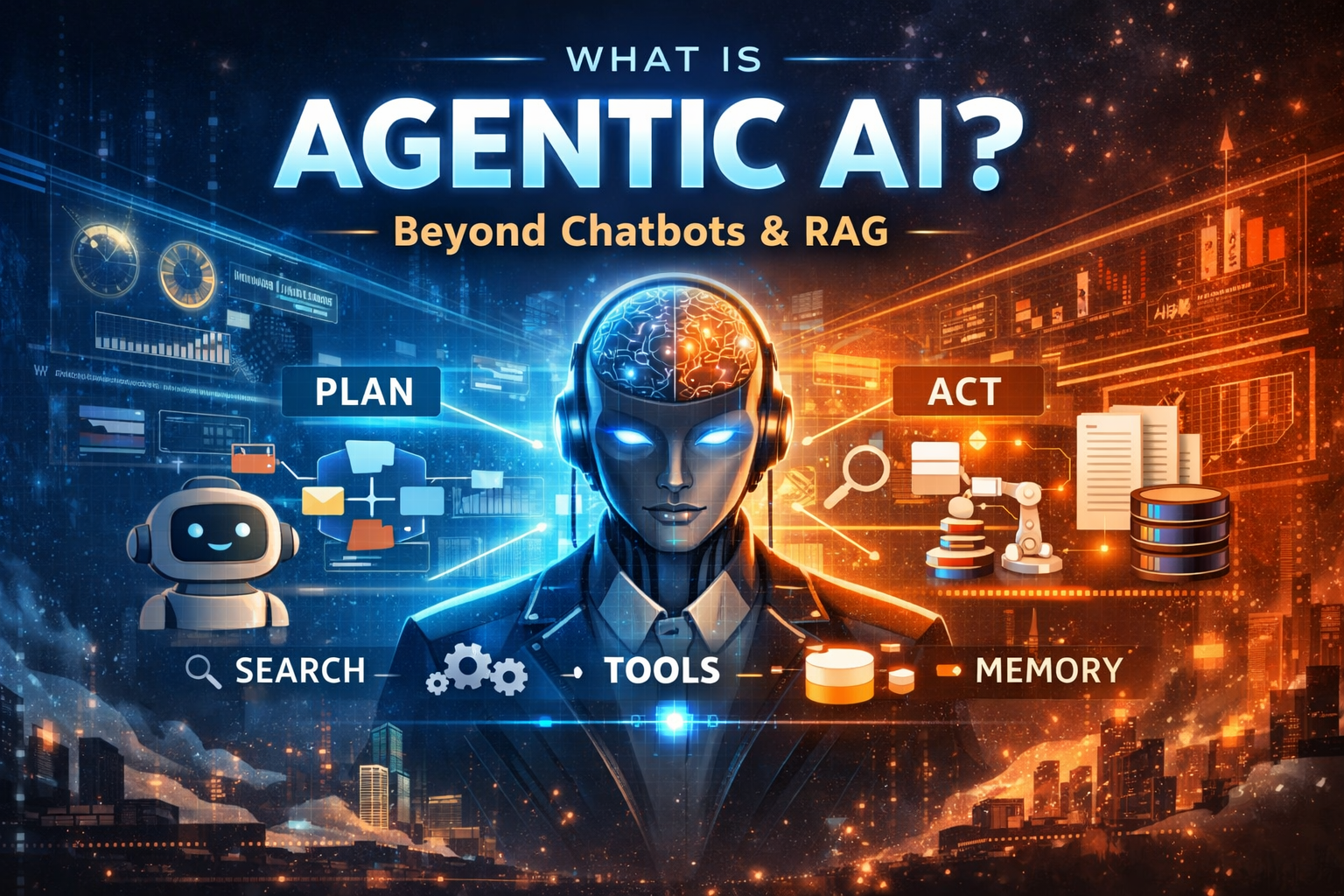
Introduction: Why "Agentic AI" Is the Next Big Shift
For years, AI systems have been reactive . - You ask a question AI answers. - You search data AI summarizes. - You retrieve documents AI paraphrases. This worked well for chatbots and RAG (Retrieval Augmented Generation) systems. But modern problems- policy analysis, historical reasoning, enterprise decision-making, and government workflows -need more than just answers. They need AI that can think, plan, act, and learn . That's where Agentic AI comes in.
What Is Agentic AI? (Simple Definition)
Agentic AI is a type of artificial intelligence system that can: - Understand a goal - Plan multiple steps - Use tools and data sources - Reason over history and context - Take actions - Evaluate outcomes and adapt In short: Agentic AI behaves less like a chatbot and more like a junior analyst, assistant, or decision-support officer.
1. Traditional Chatbots
Chatbots: - Respond only to user prompts - Have no memory of past interactions - Cannot take actions - Do not verify or plan They are reactive , not proactive.
2. RAG (Retrieval Augmented Generation)
RAG improved things by: - Fetching documents - Grounding responses in data - Reducing hallucinations But RAG still: - Answers one question at a time - Cannot plan multi-step tasks - Cannot decide what to do next
Key Limitation
Both chatbots and RAG wait for instructions . Agentic AI creates and executes its own plan .
Chatbot vs RAG vs Agentic AI
Suggested Infographic Layout:
1. Goal-Oriented Behavior
Agentic AI doesn't just respond-it works toward a goal . Example goals: - "Analyze past tenders and suggest the best bid strategy" - "Review 10 years of policy changes and summarize impacts" - "Compare historical market trends and predict risks"
2. Planning & Reasoning
Agentic AI breaks a goal into steps: - Identify required data - Retrieve relevant history - Analyze patterns - Validate assumptions - Generate output - Recommend actions This is called the Plan Act Observe Reflect loop .
3. Tool Usage
Unlike chatbots, Agentic AI can: - Query databases - Search internal systems - Call APIs - Read files (PDFs, Excel, CSV) - Trigger workflows It does things , not just says things .
4. Memory & Context Awareness
Agentic AI maintains: - Short-term memory: current task context - Long-term memory: historical knowledge - Episodic memory: past decisions & outcomes This makes it ideal for historical reasoning systems .
Scenario: Historical Policy Analysis
User Goal: "Analyze how industrial policy changes from 2010-2024 impacted MSMEs." Agentic AI Steps: - Search policy documents by year - Extract MSME-related clauses - Compare policy changes chronologically - Identify impact patterns - Cross-reference outcomes - Generate insights + recommendations A chatbot would summarize documents . Agentic AI builds an analysis .
Core Components:
- LLM (Reasoning Brain) - Memory Layer (Vector DB + Structured DB) - Tool Layer (APIs, Search, Databases) - Planner / Orchestrator - Guardrails & Governance - Human-in-the-Loop (Optional)
Backend Developers & Data Science Beginners
- Learn system design beyond prompts - Build real-world AI workflows - Move from "toy chatbots" to production systems
Government & Public Sector Managers
- Policy comparison & precedent analysis - Decision traceability - Reduced dependency on manual research
Enterprises & Large Clients
- Strategic intelligence - Risk analysis - Faster, explainable decisions
Agentic AI vs Autonomous AI (Important Clarification)
Agentic AI is not fully autonomous by default . Most real-world systems today use controlled agentic AI .
Common Misconceptions About Agentic AI
"Agentic AI is just better prompting" It's system-level design "Agentic AI replaces humans" It augments decision-making "Only big companies can use it" Scalable from startups to governments
Real-World Use Cases
- Historical intelligence systems (Rufus-style) - Tender & procurement analysis - Enterprise knowledge assistants - Policy impact simulators - Compliance & audit assistants - Strategic planning tools